
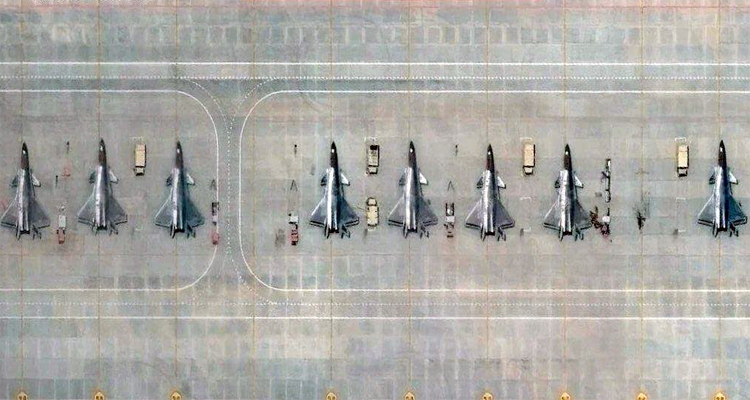
12 Chinese J-20 Stealth Fighters Spotted Near India Border in New Satellite Images
New Delhi: China has significantly bolstered its air power along the Line of Actual Control (LAC), with fresh commercial satellite imagery revealing the deployment of at least 12 Chengdu J-20 “Mighty Dragon” fifth-generation stealth fighter jets at two military airbases close to India’s northern frontier. Defence analysts say the move represents one of the largest publicly documented concentrations of China’s most advanced combat aircraft near the India-China border.
The images, captured between late June and early July, show seven J-20 stealth fighters stationed at Hotan Air Base in Xinjiang—around 400 km from Ladakh—and four more at Damxung Air Base in Tibet, approximately 340 km from Arunachal Pradesh’s Tawang sector. The deployments were identified through commercial satellite imagery analysed by defence experts.
Largest Visible J-20 Deployment Near India
Military analysts describe the deployment as an unprecedented visible concentration of J-20 fighters opposite India. While the People’s Liberation Army Air Force (PLAAF) has operated J-20s in western China before, the current build-up places a larger number of stealth aircraft at forward bases capable of rapidly responding to developments along the disputed Himalayan frontier.
🚨 China has increased operational deployments of its frontline J-20 ‘Mighty Dragon’ stealth fighters at airbases positioned against India.
Satellite imagery from Vantor indicates that eleven J-20s were stationed across two bases during late June and early July this year. pic.twitter.com/tFrgCurcea
— Global News & Geopolitics 🌍 (@GlobalNewsGeo) July 28, 2026
The Hotan airbase overlooks the western sector facing Ladakh, while Damxung provides air coverage over the eastern theatre opposite Arunachal Pradesh. Their locations enable the PLAAF to project air power across key sectors of the LAC within a short response time.
Why the J-20 Matters
The Chengdu J-20 “Mighty Dragon” is China’s first operational fifth-generation stealth fighter and is regarded as the backbone of the PLAAF’s modern air combat fleet. Designed for long-range missions, the aircraft combines stealth technology, advanced avionics, powerful sensors and beyond-visual-range missile capability, enabling it to detect and engage adversaries before being detected itself.
The aircraft is intended to rival other fifth-generation fighters such as the American F-22 Raptor and F-35 Lightning II, and its forward deployment reflects China’s growing emphasis on high-end air superiority in the Himalayan region.
Strategic Message to India
Defence observers believe the deployment is aimed at strengthening China’s deterrence posture along the contested border while showcasing the PLAAF’s ability to operate advanced stealth platforms from high-altitude bases.
The move comes despite ongoing diplomatic efforts by New Delhi and Beijing to stabilise bilateral ties following years of military tensions after the 2020 Galwan Valley clashes. Both countries have continued military-level and diplomatic dialogue while gradually restoring limited engagement in other sectors.
India’s Air Power Response
India has significantly upgraded its own military posture along the northern frontier over the past few years. The Indian Air Force has deployed Rafale multirole fighters to forward bases, strengthened infrastructure in Ladakh and Arunachal Pradesh, and enhanced surveillance through advanced radar systems, drones and missile deployments.
New Delhi is also progressing with the development of the indigenous Advanced Medium Combat Aircraft (AMCA)—India’s planned fifth-generation stealth fighter—while expanding the capabilities of the Tejas Mk-1A and upgrading its Su-30MKI fleet.
Satellite Images Highlight Changing Military Balance
Commercial satellite imagery has increasingly become an important source for tracking military deployments across the Himalayas. Analysts note that the latest images provide rare visual confirmation of China’s expanding fifth-generation fighter presence near India’s borders, underlining Beijing’s sustained military modernisation in the region.
While Chinese authorities have not officially commented on the reported deployment, defence experts say the development reflects the evolving strategic competition between Asia’s two largest military powers and highlights the growing importance of air superiority in any future border contingency.