
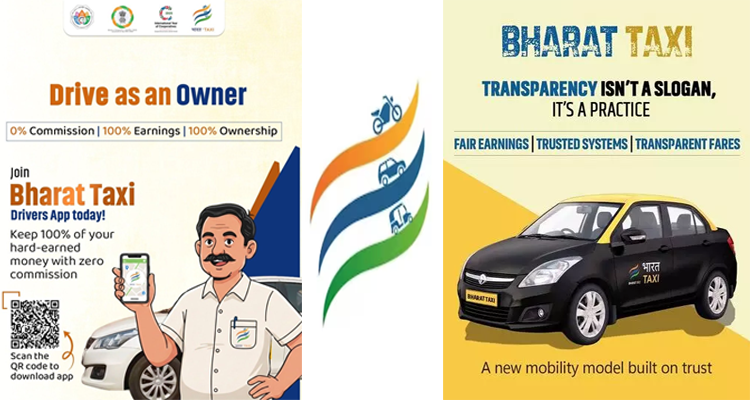
New Delhi: Bharat Taxi — India’s first cooperative-based ride-hailing platform — was formally launched in the national capital on Thursday, marking a significant new entry into the country’s urban mobility market. The service was inaugurated at Vigyan Bhavan by Union Home and Cooperation Minister Amit Shah, positioning the platform as a driver-centric alternative to dominant private aggregators.
माननीय गृह मंत्री श्री अमित शाह जी ने विज्ञान भवन में दीप प्रज्वलित कर भारत टैक्सी कार्यक्रम का शुभारम्भ किया।#NAFEDIndia #SahkarSeSamriddhi #BharatTaxi pic.twitter.com/AZyB786eU5
— NAFED India (@nafedindia) February 5, 2026
The initiative represents a distinct structural departure from venture-backed gig-economy operators such as Uber and Ola, which function as privately owned platforms. Bharat Taxi is built on a cooperative ownership model designed to place drivers at the centre of ownership, operations and value creation.
सहकारी मॉडल पर आधारित ‘सहकार टैक्सी’ आने वाले वर्षों में देश की सबसे बड़ी टैक्सी सेवा बनेगी। pic.twitter.com/zt0bKlnqMF
— Amit Shah (@AmitShah) December 5, 2025
Cooperative Model and Minister’s Remarks
Addressing the launch, Shah described the platform as an example of how collective cooperation can mobilise small individual investments into large economic opportunities. In public remarks and social media posts, he said the service aims to bring people together through cooperation, enabling citizens — particularly drivers — not only to earn higher profits but also to become owners with dignity. He called the launch an important milestone for taxi drivers, noting that Bharat Taxi is the first taxi service in the cooperative sector initiated for their benefit.
The platform has been conceived under the broader “Sahkar se Samriddhi” vision to strengthen cooperative-driven economic participation, while offering a citizen-centric mobility solution.
How the Platform Works
Registered under the Multi-State Cooperative Societies Act, 2002, Bharat Taxi operates through Sahakar Taxi Cooperative Ltd., where drivers — referred to as Sarathis — are shareholders rather than contracted gig workers.
The model eliminates commission charges and surge pricing, enabling drivers to retain full ride earnings while also sharing cooperative profits.
Officials say fares may be up to 30% lower than competitors in certain cases, reflecting the zero-commission approach.
The service also emphasises welfare provisions, including health and accident insurance, retirement savings options, and emergency support systems.
Scale, Features and Expansion
More than three lakh drivers have already joined the platform, with over one lakh registered users and roughly 10,000 daily rides recorded during pilot operations in Delhi-NCR and Gujarat.
The cooperative has distributed about ₹10 crore directly to drivers and plans nationwide expansion over the next two years.
Key app features include transparent fare structures, vehicle tracking, multilingual interface support, and 24×7 customer service, alongside safety integration with public systems.
Women-focused initiatives such as “Bike Didi” and “Sarathi Didi” have also been introduced to broaden participation in the sector.
Market Implications
Industry observers view Bharat Taxi as a strategic attempt to reshape the ride-hailing landscape by challenging commission-driven aggregator models through cooperative ownership. By allowing drivers to work simultaneously on other platforms while retaining profit-sharing rights, the model aims to combine flexibility with economic stakeholding.
As the platform scales nationwide, its success will likely be measured by its ability to balance affordability for passengers with sustainable income growth for drivers — potentially redefining how India’s gig-mobility ecosystem evolves in the coming years.