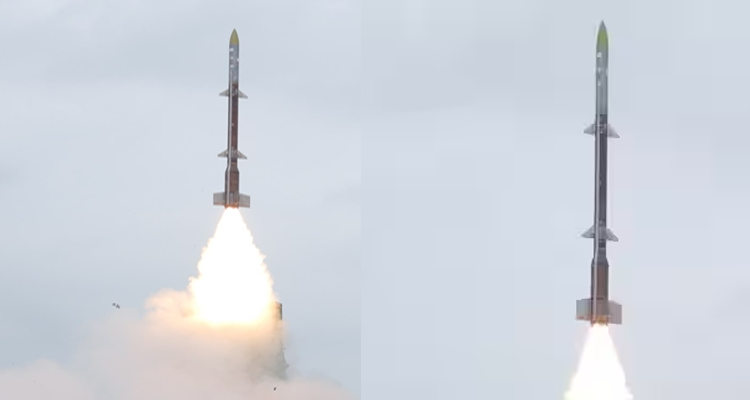
New Delhi: India on Thursday achieved a major milestone in its indigenous defence programme as the Defence Research and Development Organisation (DRDO) successfully carried out the maiden flight test of the ‘Kusha’ Long-Range Surface-to-Air Missile (LR-SAM) system, significantly boosting the country’s air defence capabilities and reducing reliance on imported missile shields.
The flight test was conducted from APJ Abdul Kalam Island off the coast of Odisha. During the trial, the missile successfully intercepted a high-speed, high-altitude electronic target simulating an incoming aerial threat, meeting all mission objectives and validating the performance of the indigenous system.
The Kusha missile system is designed to neutralise a broad spectrum of aerial threats, including fighter aircraft, cruise missiles, unmanned aerial vehicles (UAVs), missiles and large enemy aircraft across a wide range of altitudes and engagement distances. According to the Ministry of Defence, the missile, radars, command-and-control centre and other key components have all been developed by DRDO laboratories in collaboration with Indian industry partners, underscoring India’s growing self-reliance in advanced defence technologies.
Maiden flight-test of ‘Kusha’ Long-Range Surface-to-Air Missile was successfully conducted from the APJ Abdul Kalam Island off the coast of Odisha today. This test was conducted against an electronic target simulating high-speed and high-altitude aerial threat which was… pic.twitter.com/UeJgNOtCm5
— DRDO (@DRDO_India) July 23, 2026
Defence Minister Rajnath Singh hailed the successful maiden flight as a landmark achievement in Indian defence research and development. He said only a handful of countries possess the capability to develop long-range surface-to-air missile systems indigenously, adding that the Kusha programme would substantially reduce India’s dependence on foreign air defence systems while marking a giant leap in the nation’s air defence preparedness.
Defence Secretary and DRDO Chairman Rajesh Kumar Singh, who monitored the launch, congratulated the scientists, engineers and industry partners involved in the successful trial.
Project Kusha is envisioned as India’s next-generation layered air defence shield and is often compared with Russia’s S-400 system because of its long-range interception capability. The programme is expected to feature multiple interceptor variants with planned engagement ranges of 150 km, 250 km and up to around 400 km, enabling the system to tackle diverse aerial threats at varying distances. Further developmental trials are expected before the system enters operational service.
The successful test comes at a time when India is accelerating efforts to strengthen its indigenous defence manufacturing ecosystem under the ‘Aatmanirbhar Bharat’ initiative. Defence experts believe the Kusha programme will form a critical layer in India’s integrated air defence architecture, enhancing the country’s ability to counter modern aerial threats while reinforcing strategic autonomy in the defence sector.