
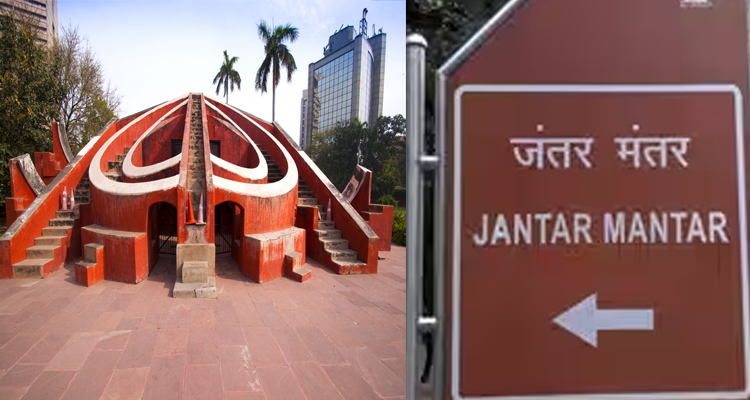
New Delhi: Delhi Police has removed Jantar Mantar from the list of officially designated protest venues and named three alternative locations for demonstrations: Ramlila Ground, Burari Ground and CBD Ground in Shahdara.
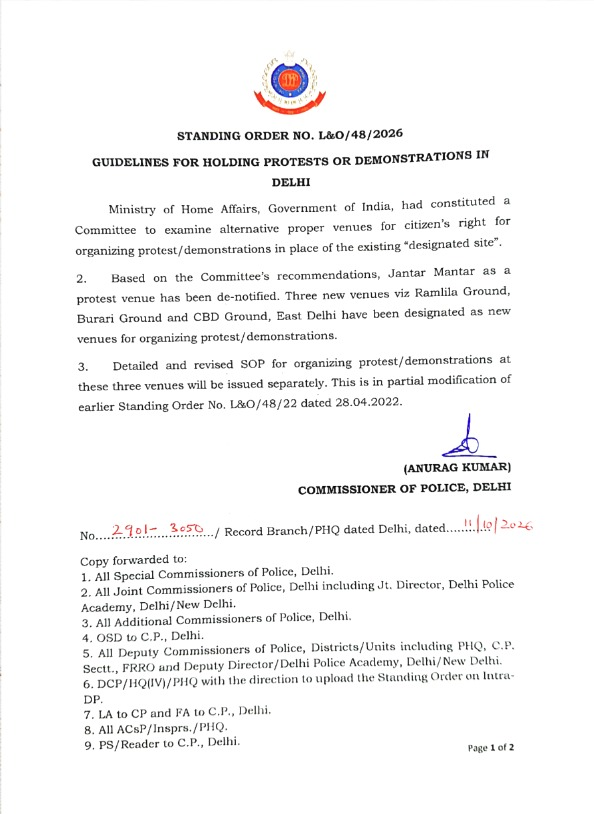
The decision follows recommendations from a committee constituted by the Union Ministry of Home Affairs to examine alternative locations for public protests in the national capital. Delhi Police Commissioner Anurag Kumar issued the order on October 11, partially modifying the existing standing order dated April 28, 2022.
Delhi Police has indicated that revised standard operating procedures (SOPs) governing demonstrations at the newly designated venues will be issued separately.
Three New Venues for Public Protests
The three locations are spread across different parts of Delhi. Ramlila Ground in central Delhi is a traditional venue for political rallies and large public gatherings. Burari Ground in north Delhi and CBD Ground in Shahdara, east Delhi, will provide additional designated spaces for demonstrations.
The revised arrangement is expected to change how political parties, social organisations, activists and other groups organise protests in the capital. Organisers will have to comply with the applicable permission requirements and the revised procedures once they are issued.
#BreakingNews | Ministry of Home Affairs, Government of India, had constituted a Committee to examine alternative proper venues for citizen’s right for organizing protest/demonstrations in place of the existing “designated site”.
Based on the Committee’s recommendations, Jantar Mantar as a protest venue has been de-notified. Three new venues viz Ramlila Ground, Burari Ground and CBD Ground, East Delhi have been designated as new venues for organizing protest/demonstrations.
Detailed and revised SOP for organizing protest/demonstrations at these three venues will be issued separately. This is in partial modification of earlier Standing Order No. L&O/48/22 dated 28.04.2022.
— DD News (@DDNewslive) October 12, 2026
Jantar Mantar’s Long History of Public Protests
Jantar Mantar has been one of India’s most recognisable centres of public dissent for decades. Located in central Delhi, the area has hosted demonstrations by political parties, civil society organisations, farmers, workers and activists seeking to draw the government’s attention to their demands.
The venue gained national prominence during Anna Hazare’s anti-corruption movement in 2011. It has also witnessed protests by Tamil Nadu farmers, wrestlers and numerous groups campaigning on social, political and economic issues.
Its central location has made it a prominent platform for protesters seeking public visibility and access to the corridors of power.
However, the site has also faced restrictions over concerns relating to noise, sanitation, traffic and the management of large gatherings. In 2017, the National Green Tribunal intervened over environmental and public nuisance concerns associated with protests in the area.
In July 2018, the Supreme Court ruled against a blanket ban on protests at Jantar Mantar and the Boat Club area, while recognising that demonstrations could be regulated through reasonable restrictions.
Concerns Over Accessibility and Freedom of Expression
The decision to remove Jantar Mantar from the list of designated protest venues has raised concerns among activists about the accessibility and visibility of public demonstrations.
Critics argue that the location of a protest can be important to its effectiveness, particularly when demonstrators want to communicate their demands to government authorities and attract public attention. Moving protests to alternative grounds could affect the participation of citizens and the visibility of certain campaigns.
At the same time, authorities must manage public safety, traffic congestion and law-and-order requirements in a densely populated city such as Delhi. Designating specific locations for demonstrations is one way of regulating public gatherings while attempting to minimise disruption to daily life.
The effectiveness of the new arrangement will depend partly on how permissions are granted, what conditions are imposed and how accessible the designated venues are to protesters from different parts of the capital.
Constitutional Right to Peaceful Assembly
The removal of Jantar Mantar’s designated status does not, by itself, abolish the constitutional right to peaceful assembly. Article 19(1)(b) of the Constitution guarantees citizens the right to assemble peaceably and without arms, subject to reasonable restrictions permitted under Article 19(3).
The practical exercise of this right remains subject to applicable laws, lawful restrictions and permission requirements.
The revised SOPs are therefore expected to play an important role in determining how demonstrations can be organised at Ramlila Ground, Burari Ground and CBD Ground in Shahdara.
For political organisations, civil society groups and activists, the immediate task will be to familiarise themselves with the new arrangements. For Delhi Police, the challenge will be to maintain public order while facilitating lawful and peaceful expressions of public opinion.
The change marks a significant administrative shift in Delhi’s protest-management system. Whether the three newly designated venues can provide an effective alternative to Jantar Mantar will become clearer as protesters and authorities begin operating under the revised arrangements.