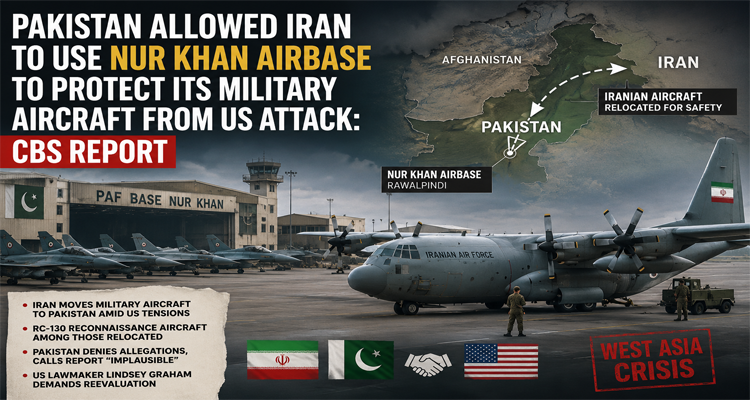
News Desk: Pakistan quietly allowed Iran to use the strategically sensitive Pakistan Air Force (PAF) Base Nur Khan near Rawalpindi to shelter military intelligence aircraft during the recent Iran-US conflict, according to a report by CBS News, citing multiple American officials familiar with the matter.
The disclosures have cast fresh scrutiny on Islamabad’s role as a self-proclaimed mediator in the West Asia crisis, even as it allegedly provided logistical support to Tehran amid fears of possible US military strikes.
According to the report, Iran moved several aircraft to the Pakistani airbase shortly after US President Donald Trump announced a temporary ceasefire in early April. Among them was reportedly an Iranian Air Force RC-130 reconnaissance aircraft — a surveillance and intelligence-gathering variant of the Lockheed C-130 Hercules.
Pakistan BACKSTABS US: While “mediating” a US-Iran ceasefire, Islamabad allowed Iranian military jets—including an RC-130 recon plane—to park at Nur Khan Air Base next to Rawalpindi’s military HQ, shielding Tehran’s assets.
Classic betrayal—playing all sides while pretending to… pic.twitter.com/Xfl4dmC8VJ
— Megh Updates 🚨™ (@MeghUpdates) May 12, 2026
US officials quoted by CBS said Tehran appeared to be dispersing key aviation assets across the region to prevent them from becoming targets if the conflict escalated into a broader war. Iran was also said to have relocated civilian aircraft to neighbouring Afghanistan after portions of its airspace became vulnerable during the hostilities.
PAF Base Nur Khan, located near the garrison city of Rawalpindi, is considered one of Pakistan’s most strategically important military installations and is closely linked to the country’s air mobility and command infrastructure.
However, Pakistan strongly denied the allegations. A senior Pakistani official dismissed claims that Iranian military aircraft were stationed at the airbase, arguing that such activity could not remain hidden due to the facility’s location in a densely populated urban zone.
US accuses Pakistan of ‘SHIELDING’ Iranian military aircraft from airstrikes
Planes allowed to PARK on Pakistani airfields — officials to CBS pic.twitter.com/zx7s1aLDm0
— RT (@RT_com) May 11, 2026
“Nur Khan base is right in the heart of the city. A large fleet of aircraft parked there cannot be hidden from public view,” the official was quoted as saying.
The report further claimed that an aircraft operated by Iran’s Mahan Air landed in Kabul shortly before the conflict intensified and remained there after Iranian airspace was shut down. Afghan aviation officials reportedly said Taliban authorities later shifted the aircraft to Herat near the Iranian border amid fears that possible Pakistani airstrikes targeting militant groups could threaten Kabul airport.
Taliban spokesperson Zabihullah Mujahid, however, denied that Iranian aircraft were being sheltered in Afghanistan and rejected suggestions that Tehran required such assistance.
The revelations come at a time when Pakistan’s strategic ties with China have significantly deepened. Chinese officials have publicly praised Islamabad’s role in facilitating indirect communication between Tehran and Washington during the crisis.
The controversy has also triggered political reactions in the United States. Senior Republican senator Lindsey Graham questioned Pakistan’s neutrality in the mediation process and called for a reassessment of Islamabad’s diplomatic role.
“If this reporting is accurate, it would require a complete reevaluation of the role Pakistan is playing as mediator between Iran, the United States and other parties,” Graham wrote on X, adding that he would not be surprised if the allegations proved true given past statements by Pakistani defence officials regarding Israel.
President Trump had earlier agreed to extend the ceasefire after reportedly receiving requests from Pakistan Army chief General Asim Munir and Prime Minister Shehbaz Sharif. However, negotiations between Washington and Tehran remain stalled over Iran’s uranium enrichment programme, sanctions relief and demands for war reparations.
Iranian state media recently reported that Tehran’s proposed framework for ending the conflict includes recognition of Iranian sovereignty over the Strait of Hormuz, lifting of US sanctions and compensation for wartime damages. Trump has reportedly dismissed the proposal as “totally unacceptable.”
The ongoing diplomatic deadlock is expected to dominate Trump’s upcoming meetings with Chinese President Xi Jinping in Beijing, alongside tensions over trade and Taiwan.
Meanwhile, analysts have questioned Pakistan’s claim of neutrality. Farzana Shaikh, associate fellow at Chatham House in London, told the Financial Times that Pakistan “is not truly a neutral party,” citing its longstanding strategic relationships with the United States and Gulf nations, as well as its interest in limiting Iran’s nuclear ambitions.