
India’s first space-based solar observatory, Aditya-L1, has made a significant breakthrough in understanding solar eruptions, revealing that powerful bursts of solar material do not expand uniformly in all directions. The discovery offers fresh insights into the behaviour of solar storms and could help scientists improve space-weather forecasting.
The research, conducted by scientists at the Indian Institute of Astrophysics (IIA), Bengaluru, used observations from Aditya-L1’s Visible Emission Line Coronagraph (VELC), NASA’s Solar Dynamics Observatory (SDO) and advanced three-dimensional modelling.
Published in The Astrophysical Journal Letters, the study challenges the conventional assumption that coronal mass ejections (CMEs) expand like uniformly growing bubbles.
Solar eruptions expand unevenly
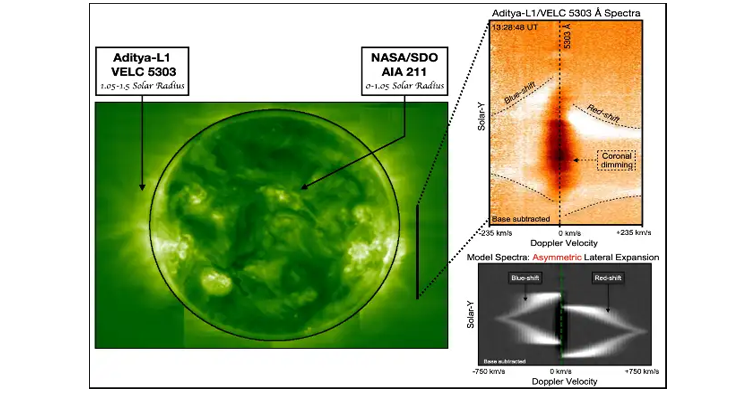
The researchers examined a coronal mass ejection observed on August 5, 2024, originating from an active region near the western edge of the Sun.
Aditya-L1’s VELC instrument detected unusual spectral signatures, including blue-shifted and red-shifted emissions. These indicated that hot solar plasma was moving in opposite directions, both towards and away from the spacecraft.
While NASA’s Solar Dynamics Observatory captured the eruption’s movement across the solar disc, Aditya-L1 provided crucial information about the plasma’s motion along the line of sight, helping scientists understand its three-dimensional structure.
3D modelling reveals asymmetric behaviour
To explain the observations, the research team developed a three-dimensional model of the expanding solar eruption.
The analysis showed that a model based on uniform expansion could not explain the observed spectral patterns. However, a model incorporating an inclined eruption axis and uneven sideways expansion closely matched the observations.
The findings indicate that coronal mass ejections can expand at different rates in different directions, developing asymmetric structures as they move away from the Sun.
Why the discovery matters
Coronal mass ejections are massive releases of hot, magnetised plasma from the Sun’s outer atmosphere. When directed towards Earth, they can interact with the planet’s magnetic field and trigger geomagnetic storms.
These storms can disrupt satellite operations, radio communications, navigation systems and, in severe cases, power infrastructure.
The shape and expansion pattern of a solar eruption influence how it interacts with the surrounding solar wind and how quickly it travels through space. Uneven expansion could therefore affect its speed, trajectory and arrival time near Earth.
A better understanding of these characteristics could help scientists develop more accurate models to predict the movement and potential impact of solar storms.
Aditya-L1 strengthens India’s solar research capabilities
Launched in September 2023, Aditya-L1 is India’s first dedicated solar mission. Positioned around the Sun-Earth Lagrange Point 1 (L1), approximately 1.5 million kilometres from Earth, it provides an uninterrupted view of the Sun.
Its VELC instrument studies the solar corona by analysing the light emitted by highly ionised iron atoms. By detecting changes in the wavelength of this light, scientists can measure the movement of solar material towards or away from the spacecraft.
The latest findings highlight the growing importance of Aditya-L1 in solar physics and demonstrate how India’s space programme is contributing to a deeper understanding of solar activity.
Researchers hope that applying this technique to more solar eruptions will provide further insights into their three-dimensional behaviour and contribute to more reliable space-weather predictions.
The study, titled “Spectroscopic Signatures of Nonuniform Lateral Expansion of a Coronal Mass Ejection in the Low Corona with ADITYA-L1/VELC”, was published in The Astrophysical Journal Letters.